
If you run a manufacturing business, you already know the frustration: a production order goes out, the shop floor asks for a component that isn't in stock, and suddenly a two-day job takes a week. Nine times out of ten, the root cause traces back to one document — the Bill of Material.
For small and mid-sized manufacturers, the BOM isn't paperwork. It's the single source of truth that connects design, purchasing, inventory, production, and costing. Get it wrong — or manage it in a spreadsheet that three people edit differently — and every downstream process inherits the error. This guide walks through what a BOM actually is, why it matters more than most SMEs realize, and how a proper BOM in ERP setup removes the guesswork from production.
What Is a Bill of Material (BOM)?
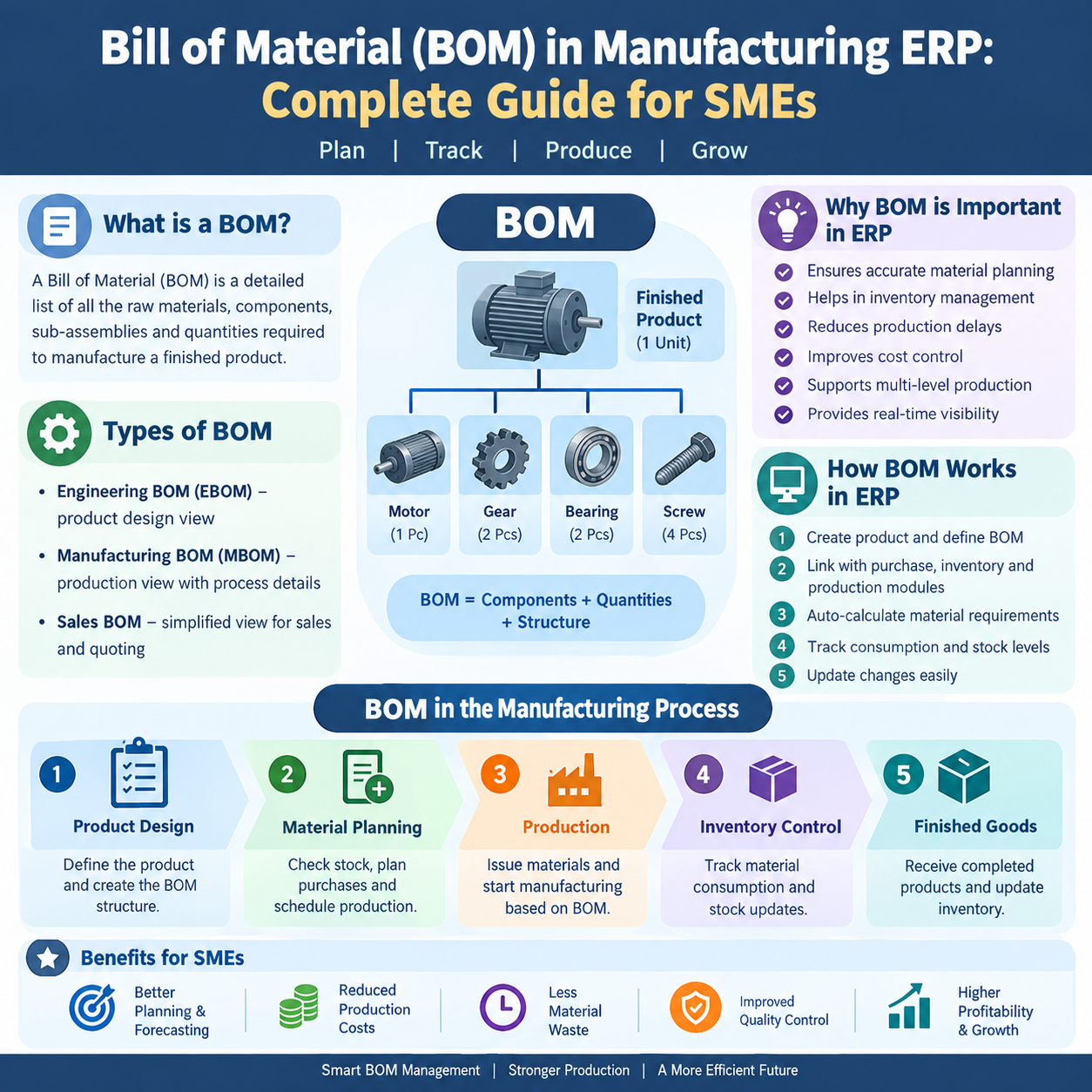
A Bill of Material is a structured list of every raw material, component, sub-assembly, and quantity required to manufacture a finished product. Think of it as a recipe: it tells you not just what goes into a product, but how much of each item, in what unit of measure, and often in what sequence.
A typical BOM line includes:
Item code and description — the raw material or component
Quantity per unit — how much is needed to build one unit of the parent item
Unit of measure — kg, meters, pieces, liters, etc.
Scrap or wastage percentage — realistic material loss during processing
Reference designator or operation — where in the process the item is consumed
Without this structure, purchasing doesn't know what to buy, planning doesn't know what to schedule, and finance can't tell you what a product actually costs to make.
Why BOM Accuracy Is Critical for Manufacturing
The BOM sits upstream of almost every operational decision:
Material planning — Purchase and production planning both start from the BOM. An incorrect quantity here means either excess inventory sitting idle or a stockout that halts the line.
Costing accuracy — Product cost is built bottom-up from the BOM's material list plus labor and overhead. A stale BOM gives you a wrong cost, which means wrong quotations and eroded margins.
Production scheduling — Work orders are generated against the BOM. If the BOM doesn't reflect the current engineering revision, the shop floor builds the wrong version of the product.
Quality and traceability — When a defect is traced back to a batch, the BOM (tied to the right revision) tells you exactly which components and lots were used.
Vendor and procurement negotiation — Aggregated BOM demand across multiple work orders gives purchasing real leverage on volume-based negotiations.
In short, a BOM error doesn't stay contained — it multiplies across planning, inventory, shop floor, and finance.
Types of BOM Structures
Not every manufacturer needs the same BOM structure. The right structure depends on how complex your product is and how it's built.
1. Single-Level BOM
Lists only the immediate components needed to build the finished product, with no further breakdown. Suitable for simple products assembled directly from purchased raw materials.
2. Multi-Level BOM
Reflects the real hierarchy of manufacturing: a finished product is made of sub-assemblies, and each sub-assembly is itself made of raw materials or further sub-components. This is standard in most engineering, machinery, and fabrication businesses where components are manufactured in-house before final assembly.
Example: A pump (finished good) → motor sub-assembly + housing sub-assembly → each sub-assembly broken down into its own raw materials and purchased parts.
Multi-level BOMs are essential once your product has more than one manufacturing stage, because they let planning and costing roll up correctly at each level rather than treating the entire product as a flat list.
3. Configurable / Variant BOM
Used when a base product has multiple configurable options (size, color, capacity, add-ons). Instead of maintaining a separate BOM for every variant, a configurable BOM lets you generate the exact BOM based on selected options at order time.
4. Engineering BOM (EBOM) vs. Manufacturing BOM (MBOM)
The EBOM reflects how a product is designed (from drawings and specifications), while the MBOM reflects how it's actually built on the shop floor, including process-specific items like consumables, fixtures, and packaging. SMEs that don't distinguish between the two often end up with production orders that don't match what engineering intended.
Raw Materials, Sub-Assemblies, and Multi-Level Planning
In a multi-level BOM, materials fall into distinct categories, and each behaves differently in planning:
Raw materials — purchased directly, consumed at the lowest level of the BOM. Lead time and reorder points matter most here.
Sub-assemblies — manufactured in-house before being consumed by a higher-level BOM. These need their own work orders, routing, and costing, distinct from the parent item.
Bought-out components — purchased ready-made (fasteners, bearings, electronic parts) and consumed directly like raw materials but tracked separately for vendor and quality purposes.
The planning complexity grows with each level. A single finished good with three levels of sub-assemblies can translate into dozens of purchase requirements once the BOM is exploded — which is exactly the kind of calculation that becomes unreliable in a spreadsheet as volumes grow.
BOM Revisions: Why Version Control Matters
Products change — a supplier substitution, a design improvement, a cost-reduction initiative. Every change needs a new BOM revision, because:
Open work orders may need to continue on the old revision while new orders use the updated one.
Costing has to reflect the revision that was actually used for a given batch, not just the latest version.
Quality issues need to be traceable to the exact revision and components used at the time of production.
Manufacturers who manage BOMs on paper or in Excel almost always lose track of revisions. Someone updates "the" BOM file, overwrites the previous version, and there's no record of what changed, when, or why — until a customer complaint forces someone to reconstruct history from memory and email threads.
How BOM Drives Production Planning, Inventory, and Costing
Production Planning
When a sales order or production plan is created, the BOM is "exploded" to calculate exactly what materials and sub-assemblies are needed, at what quantities, and by when. This explosion is what allows a planner to convert a demand forecast into an actual material and capacity plan.
Inventory Requirements
BOM-driven Material Requirement Planning (MRP) compares what's needed (from exploded BOMs) against what's in stock and what's already on order, generating accurate purchase and production suggestions. Without this, inventory decisions are based on gut feel or reorder habits — leading to either excess working capital tied up in stock or last-minute expediting.
Product Costing
Standard costing rolls up material cost (from the BOM), labor cost (from routing/operations), and overhead into a per-unit cost. Since the BOM defines material consumption per unit, any inaccuracy here directly distorts your quoted price, margin analysis, and profitability reporting by product or customer.
The Problem with Excel and Paper-Based BOMs
Most SMEs start with Excel, and it works — until it doesn't. Common failure points:
No single source of truth. Multiple versions of the same BOM float around in emails and shared drives, and nobody is sure which is current.
Manual explosion errors. Calculating multi-level material requirements by hand or through nested spreadsheet formulas is slow and error-prone, especially as product complexity grows.
No link to actual consumption. Excel BOMs don't automatically reduce stock or record what was actually used on the shop floor, so inventory records drift further from reality with every production run.
No revision history. As covered above, overwritten files erase the audit trail needed for quality and compliance.
Disconnected costing. Costing exercises become periodic, manual re-calculations rather than a live number reflecting current material prices and consumption.
Dependency on individuals. When the one person who "knows the BOM system" is on leave or leaves the company, planning stalls.
These aren't hypothetical risks — they're the most common reason SME manufacturers underquote jobs, run into surprise stockouts, or fail audits that ask for revision traceability.
How ERP Improves BOM Accuracy
A manufacturing ERP with proper BOM functionality solves these problems structurally, not just cosmetically:
Single, controlled BOM master — one version is "active" at any time, with full revision history and approval workflow for changes.
Automatic multi-level explosion — MRP runs use the BOM directly to calculate purchase and production requirements across every level, instantly and consistently.
Live linkage to inventory — when a work order consumes material, stock is reduced automatically against the exact BOM used, keeping inventory records accurate in real time.
Accurate, current costing — since material cost is pulled from live purchase rates against the BOM structure, product costing reflects reality rather than a stale Excel calculation.
Full traceability — every batch produced is tied to the BOM revision, material lots, and work order used, which is essential for both quality investigations and audits.
Role-based access and history — changes to a BOM are logged with who made them and when, removing the single-point-of-failure risk of one spreadsheet owner.
This is where BOM software and ERP software for manufacturing stop being a "nice to have" and start directly protecting margins and delivery commitments.
BOM, Work Orders, Material Consumption, and Finished Goods: How They Connect
It helps to see this as one continuous chain rather than separate modules:
BOM defines the recipe — what and how much is needed to build one unit.
A work order is generated against a specific BOM revision, for a specific quantity, with a specific due date.
Material is issued to the work order, consuming raw materials and sub-assemblies exactly as defined in the BOM — with the ERP tracking actual usage against planned usage.
Variance is captured — if actual consumption differs from the BOM (extra scrap, substitute material), the ERP flags it, which feeds back into more accurate future BOMs and costing.
Finished goods are received into stock, with the system automatically relieving the consumed components from inventory and increasing finished goods stock — keeping both sides of the ledger accurate without manual reconciliation.
This chain is also where a Manufacturing ERP earns its keep: BOM accuracy is only as useful as the work order and inventory processes it feeds into. If you're evaluating systems, it's worth reading how the full production cycle — from planning to shop floor execution — comes together in our guide to Manufacturing ERP.
For shop-floor visibility once work orders are running, our article on Production Tracking covers how real-time status updates connect back to the BOM and work order. And if your operations involve engineering changes or design iterations that feed into BOM revisions, the Engineering Day Book article explains how day-to-day engineering activity gets logged and linked to production data.
Many SMEs in India also outsource parts of production — machining, plating, or sub-assembly — to external vendors. If a portion of your BOM is fulfilled outside your own shop floor, see our guide on Job Work for how outsourced processing is tracked against the BOM and reconciled on return.
Choosing BOM Management Software in India
If you're comparing BOM management software in India, look beyond just "does it store a BOM." The questions that actually matter for SMEs:
Does it support multi-level BOMs with automatic explosion for MRP?
Can you maintain and approve BOM revisions with a clear audit trail?
Is BOM consumption linked automatically to inventory and work orders, or does someone need to update stock manually?
Does costing update automatically when the BOM or material rates change?
Can it handle configurable/variant BOMs if your products have options?
Does it integrate with job work/sub-contracting if part of your BOM is processed externally?
A system that checks these boxes turns your BOM from a static document into a live operational and financial control — which is the real value of Bill of Material software for a growing manufacturer.
FAQs
1. What is the difference between a BOM and a routing? A BOM defines what materials and quantities go into a product. Routing defines how it's made — the sequence of operations, work centers, and time required. Together, BOM and routing form the complete manufacturing definition of a product.
2. Can a single product have more than one BOM? Yes. This is common when the same product can be built with alternate materials (based on availability or cost), or when configurable/variant BOMs are used for products with multiple options.
3. How does a multi-level BOM affect lead time calculation? Each level in a multi-level BOM has its own procurement or manufacturing lead time. The ERP calculates cumulative lead time across levels, so planning accounts for the time needed to build sub-assemblies before final assembly — not just the lead time of raw materials.
4. Why does BOM accuracy matter for costing if raw material prices change frequently? Because the BOM defines the quantity of each material used, live material rates can be applied against that fixed quantity to get an updated cost in real time. Without an accurate BOM quantity, even correct material prices produce the wrong total cost.
5. Is Excel enough for a small manufacturer with only a few products? It can work temporarily for a handful of simple, single-level products with low order volume. As soon as you introduce multi-level BOMs, frequent revisions, or need inventory and costing to stay accurate automatically, Excel becomes a liability rather than a convenience.
6. How does ERP handle scrap or wastage in a BOM? Most ERP systems allow a scrap or wastage percentage to be defined per BOM line, which is factored into both material planning (so enough extra material is procured) and costing (so the true cost per unit includes expected losses).
7. What triggers a BOM revision? Common triggers include engineering design changes, supplier or material substitutions, cost-reduction initiatives, quality corrective actions, and regulatory or compliance changes. Each should result in a new controlled revision rather than an edit to the existing one.
A BOM is only as strong as the system managing it. If your business is still tracking BOMs in spreadsheets, the risk isn't just inconvenience — it's inaccurate costing, stockouts, and lost traceability. Moving BOM management into a proper manufacturing ERP is one of the highest-leverage changes an SME can make on the shop floor.
